


What is the Li Auto L-Series?
Li Auto (理想汽车) is a Beijing-based electric vehicle manufacturer founded in 2015. The company launched its first production vehicle, the Li ONE, in 2019. The current Li Auto L-Series electric SUV vehicles — L6, L7, L8, and L9 — form the complete product range as of 2026, each occupying a distinct size and price segment within the premium Chinese family SUV category.
All four models share the same core powertrain architecture: an EREV system using a 1.5-litre turbocharged four-cylinder petrol engine as a range extender, driving two electric motors (one front, one rear) via a battery pack. The engine never connects mechanically to the wheels. The vehicle is always driven electrically.
Li Auto sold over 500,000 vehicles in 2024, making it one of China's top three new-energy vehicle brands by volume, alongside BYD and Huawei-backed Aito. The L7 and L8 account for the majority of that volume. The brand's success rests on a single bet: Chinese families making the switch to electric prefer a car that eliminates range anxiety entirely, rather than one that requires a charging infrastructure they may not have at home or on their regular routes.
L6 vs L7 vs L8 vs L9: full specs comparison
The four models divide into two groups: five-seat (L6, L7) and six-seat three-row (L8, L9). Within each group, the choice comes down to battery size, suspension grade, and how much flagship technology the buyer wants. The table below compares all four on the key metrics a dealer or distributor needs.
| Spec | L6 | L7 | L8 | L9 |
|---|---|---|---|---|
| Domestic price (USD equiv.) | $34,695–$39,971 | ~$41,917 | ~$44,695 | $56,598–$70,500 |
| Length (mm) | 4,925 | 5,050 | 5,080 | 5,218–5,255 |
| Width (mm) | 1,960 | 1,995 | 1,995 | 1,998–2,000 |
| Wheelbase (mm) | 2,920 | 3,005 | 3,005 | 3,105–3,125 |
| Seating | 5 (2 rows) | 5 (2 rows) | 6 (3 rows) | 6 (3 rows) |
| Battery (kWh) | 36.8 LFP | 42.8 / 52.3 NMC | 42.8 / 52.3 NMC | 52.3 / 72.7 NMC |
| EV range CLTC (km) | 212 | 225–286 | 225–280 | 280–420 |
| Combined range CLTC (km) | 1,390 | 1,135–1,185 | 1,360–1,415 | 1,412–1,650 |
| System power (kW) | 300 | 330 | 330 | 330 |
| Torque (N·m) | 529 | 620 | 620 | 620+ |
| 0–100 km/h (s) | 5.4 | 5.3 | 5.3 | 5.3 |
| Suspension | Double wishbone / 5-link | Magic Carpet Air | Magic Carpet Air | Magic Carpet Air + active |
| Safety rating | C-NCAP 5-star | C-NCAP 5-star | C-NCAP 5-star | C-NCAP 5-star |
All prices are domestic Chinese retail (CNY converted to USD at approximate prevailing rate). International export pricing will differ — confirm with an authorised exporter or use the import cost calculator to model your landed cost.
Li Auto L6: the entry point for premium family buyers
The L6 is the smallest and most affordable model in the Li Auto lineup. At 4,925 mm long with a 2,920 mm wheelbase, it competes in the mid-size premium SUV segment — comparable in footprint to the BMW X5 or Toyota Venza, though the interior configuration prioritises rear-passenger comfort over cargo volume.
The L6 uses a 36.8 kWh LFP battery supplied by CATL, compared to the NMC packs in the L7, L8, and L9. LFP chemistry has a longer cycle life and performs better in high-heat climates, at the cost of slightly lower energy density. The 212 km CLTC pure electric range (approximately 182 km WLTP) covers the daily commute of most urban families without the petrol engine activating at all.
The suspension is a conventional double-wishbone front and five-link rear setup — capable but without the air suspension that comes standard on the L7 and above. Body roll in fast lane changes is noticeable, per real-world driver feedback. For families prioritising comfort on Chinese-standard motorways, this is a relevant trade-off at the L6's price point.
L6 key facts for buyers
- Domestic price: CNY ~249,800–288,000 (~$34,695–$39,971 USD)
- Battery: 36.8 kWh LFP (CATL) — longer cycle life, better thermal tolerance
- DC fast charge: 20–80% in 20 minutes
- Cargo: 491 litres standard; 1,923 litres with rear seats folded
- ADAS: Li AD Pro (highway NOA) on base; Li AD Max (urban NOA) on upper trims
- Warranty: 6 years / 150,000 km comprehensive
- 2026 refresh: body extended 10 mm, battery upgraded to 51 kWh
Li Auto L7: the five-seat flagship
The L7 is positioned as the five-seat flagship — longer than the L6 by 125 mm, with a 3,005 mm wheelbase that gives genuine rear legroom. The jump from L6 to L7 is not merely cosmetic. The L7 receives the Magic Carpet Air suspension system (standard across L7, L8, L9), which uses continuous air spring adjustment to absorb road imperfections without the body roll trade-off found on the L6.
The NMC battery in the L7 is available in 42.8 kWh or 52.3 kWh variants, with the larger pack delivering 286 km CLTC pure electric range — a meaningful increase over the L6's 212 km and enough to handle most urban use without the range extender engaging. System power increases from 300 kW (L6) to 330 kW, with torque rising to 620 N·m.

Li Auto L9 interior. Large central display and rear entertainment screens are standard across the L7, L8 and L9. Photo: CarNewsChina.
L7 vs L6: where the premium is justified
- Magic Carpet Air suspension — adjusts continuously based on road surface; measurably quieter ride at motorway speeds
- Larger battery options — 52.3 kWh vs 36.8 kWh; more daily EV driving, less petrol engine use
- Higher torque — 620 N·m vs 529 N·m; the difference is felt in overtaking and uphill loading
- Rear-seat legroom — 3,005 mm wheelbase vs 2,920 mm; 85 mm that matters for adult rear passengers
The L7 price premium over the L6 (~$2,200 USD at domestic pricing) is modest for what it delivers. For a dealer positioning a single model, the L7 makes a stronger retail argument than the L6 in most premium markets.
Li Auto L8: the six-seat family choice
The L8 is the three-row six-seat variant positioned directly between the L7 and L9. At 5,080 mm long with the same 3,005 mm wheelbase as the L7, the L8 achieves a third row of seating by optimising the second-row seat design rather than simply extending the body. The result is a genuinely usable third row for passengers up to 170 cm, not a folding emergency seat.
Powertrain and suspension specifications are identical to the L7 — same 330 kW system, same Magic Carpet Air, same 42.8/52.3 kWh battery options. The weight is higher (approximately 150 kg over the L7), which affects combined range marginally: 1,360–1,415 km CLTC versus 1,135–1,185 km for the L7.
The L8 is the most commercially compelling model in the Li Auto range for international family markets. Three rows of seating at a ~$2,800 premium over the L7 is a straightforward retail upsell — and in markets where family size drives purchase decisions (Middle East, Southeast Asia, parts of Africa), three rows is not optional equipment, it is the purchase criterion. The L8 competes at retail against the Toyota Land Cruiser Prado (~$55,000), BMW X5 (~$65,000), and Range Rover Sport (~$85,000). At a domestic price of $44,695, the margin opportunity for international dealers — before duty — is significant. The constraint is not the product. It is Li Auto's limited export infrastructure.
L8 key facts for buyers
- Domestic price: CNY ~319,800 (~$44,695 USD)
- Seats: 6 across three rows — second-row captain chairs, third row for two
- Suspension: Magic Carpet Air (identical to L7 and L9)
- Cargo behind third row: confirm with factory for exact figure
- Weight: ~2,450–2,500 kg curb weight
- Safety: C-NCAP 5-star, ADAS identical trim-for-trim to L7
Li Auto L9: the flagship — and the 2026 Livis refresh
The L9 is Li Auto's full-size flagship six-seat SUV. The first generation (2022–2025) established the model as China's best-selling vehicle above CNY 300,000 in multiple months. The second generation, launched in May 2026, is a comprehensive update — larger body, significantly larger battery, and a technology package that is genuinely different from the first generation rather than a facelift.
First-generation L9 (2022–2025)
- Length: 5,218 mm; width: 1,998 mm; wheelbase: 3,105 mm
- Battery: 52.3 kWh NMC
- EV range: 280 km CLTC / 235 km WLTP
- Combined range: 1,412 km CLTC
- Dual 15.7-inch interior displays (upgraded to 21.4-inch rear display in 2025 refresh)
- Price: CNY 409,800–439,800 (~$56,598–$60,741 USD)
Second-generation L9 (2026) — and the L9 Livis
- Length: 5,255 mm; width: 2,000 mm; wheelbase: 3,125 mm — larger in every dimension
- Battery: 72.7 kWh NMC — the largest in the L-Series
- EV range: 420 km CLTC / 332–340 km WLTP — 50% improvement over Gen 1
- Combined range: 1,650 km CLTC
- Steer-by-wire and four-wheel steering (5.4 m turning radius despite full-size dimensions)
- Four-LiDAR setup for urban autonomous driving
- Active suspension — goes beyond Magic Carpet Air's passive-adaptive system
- Price: CNY 459,800–509,800 (~$63,500–$70,500 USD)
- L9 Livis variant: premium interior package with duotone exterior paint
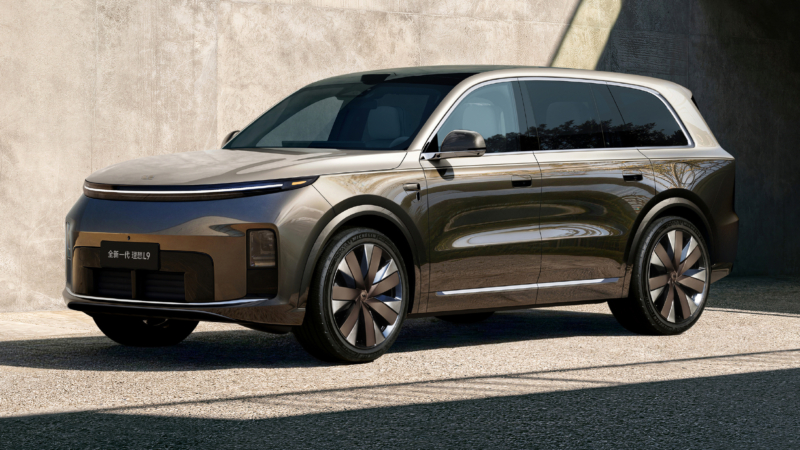
Li Auto L9 Livis — the EREV flagship. Petrol range extender means 1,650 km combined range, eliminating charging dependency for remote market buyers. Photo: CarNewsChina.
EREV architecture: what it means for markets with limited charging
The critical distinction between a Li Auto L-Series and a conventional plug-in hybrid (PHEV) is in how the petrol engine is used. In a standard PHEV, the engine can connect mechanically to the wheels at higher speeds or when the battery is depleted. In the Li Auto EREV system, the 1.5T petrol engine is permanently isolated from the drivetrain — it runs only to generate electricity for the battery. The wheels are driven by the electric motors at all times.
The practical implication for international dealers is significant. A customer who never charges the vehicle still drives it electrically — the petrol engine simply runs more often to supply power. There is no clutch engagement, no combustion-mode driving feel, no switching between power sources mid-journey. The driving experience is consistent regardless of battery state of charge.
Why EREV suits markets with incomplete charging infrastructure
In markets where public DC fast charging networks are sparse — parts of Southeast Asia, the Middle East outside major cities, large parts of Africa — a pure BEV requires significant customer education around charging behaviour and route planning. The EREV removes that friction. A driver with no charging access at all can operate the L-Series on petrol alone, achieving approximately 4.5–5.5 litres per 100 km in combined driving. A driver with home charging can cover most daily use on electricity and use petrol for longer runs.
This dual-mode capability is also relevant for fleet buyers operating mixed urban and inter-city routes where charging stop time is a cost. A fleet of L8s running primarily on electricity with petrol backup carries a lower total cost of operation than a diesel equivalent in many markets — without the charging infrastructure dependency of a pure BEV fleet.
For a direct comparison of EREV and pure BEV economics in fleet applications, see the Chinese hybrid cars guide, which covers PHEV and EREV architecture in more detail.
Import considerations for international dealers
Li Auto's international export program is in an earlier stage than BYD, MG, or XPeng. This is the single most important fact for any dealer evaluating the L-Series for import in 2026. The products are competitive — the infrastructure to support international dealers is still being built.
Current availability by market
- China: Full availability across all four models and trim levels through Li Auto's own retail network.
- Middle East / Southeast Asia: Limited authorised distribution in select markets. Confirm specific country availability directly — do not rely on general brand statements.
- Europe: Li Auto has announced European expansion but has not yet established a type-approved distribution network as of mid-2026. Individual import is technically possible but compliance costs are substantial without brand support.
- UK, Australia, Japan: Li Auto produces left-hand drive only. RHD conversion voids factory warranty. These markets are not currently viable for L-Series import.
Drive side: LHD only
All Li Auto L-Series models are left-hand drive. There are no announced plans for RHD production as of May 2026. This is a hard constraint for dealers in the UK, Australia, Thailand, Japan, South Africa, Kenya, and other RHD markets. Contrast this with BYD, which produces the Sealion 7, Atto 3, and Seal in RHD for multiple export markets.
Homologation
Li Auto vehicles do not yet hold EU-wide or UK-wide type approval. Importing an L-Series to Europe or the UK requires either Individual Vehicle Approval (IVA), which is a costly per-unit process, or waiting for Li Auto to establish market-level type approval through an authorised importer. For UAE and GCC markets, ESMA certification requirements apply — confirm the certification status for the specific model year before purchasing.
After-sales and parts
Li Auto's after-sales infrastructure outside China is minimal at present. For OTA software updates, the vehicle's Li AD system may require connection to Li Auto's servers, which could have limitations in markets where the brand has no local presence. Parts lead times from China will add complexity compared to brands with established regional distribution centres. Build this into your service commitment to end customers before making the first sale.
Pricing for international buyers
The domestic prices listed in this guide are Chinese retail prices converted to USD. International export pricing — where available — will differ from domestic prices. Add freight ($900–$1,500 per unit depending on origin port and destination), import duty (UAE: 5%; EU: 10% standard + anti-subsidy tariff up to 35.3% for some brands; UK: confirm current rate), and local compliance costs. Use the import cost calculator for a destination-specific estimate. For a direct export quote, submit an inquiry with your market, model, and quantity.
How to choose the right Li Auto model for your market
-
1
Confirm LHD is viable in your market. Li Auto makes left-hand drive only. Before evaluating any model, confirm that LHD is legally registerable and commercially viable in your destination country. If your market is RHD, Li Auto is not the right brand to pursue in 2026 — consider BYD, MG, or Jaecoo instead.
-
2
Determine whether three rows are essential. If your target buyers regularly carry six or more passengers, the L8 or L9 is the right choice. If five-seat capacity is sufficient, the L7 delivers more value than the L6 for a modest price premium. Three-row capacity commands a stronger retail price in family markets and typically has lower price resistance from buyers.
-
3
Assess the EREV benefit in your market's charging context. In markets with well-developed DC fast charging, a buyer may prefer a pure BEV. In markets where charging infrastructure is sparse or unreliable, the EREV architecture resolves the main objection to EV adoption. Match the product to the market's infrastructure reality — not to what you expect the infrastructure to become in three years.
-
4
Verify export availability and homologation before ordering. Contact Li Auto's international sales team or an authorised exporter to confirm: (a) whether the specific model and trim is available for export to your market; (b) what homologation documentation applies; (c) what the lead time is from factory to port. Do not place orders based on general brand announcements.
-
5
Build after-sales into your business plan. Li Auto's service network outside China is limited. Budget for the cost of parts sourcing, software support, and warranty fulfilment from a market where the brand has no official presence. If you cannot offer a credible service commitment to end buyers, the risk sits with your dealership, not with Li Auto. Compare this carefully against brands that have established in-market service infrastructure.
-
6
Model the landed cost before committing. Use the auto loan calculator to model retail financing for your end buyers, and the import cost calculator for the full landed-cost breakdown. A vehicle with a strong domestic price point can land at a less competitive retail price after duty, freight, and compliance costs in some markets. Run the numbers before the first container, not after.
Sourcing Li Auto or other Chinese family SUVs?
Tell us your destination market, preferred model, and order quantity. We will confirm current export availability, provide a landed-cost breakdown, and connect you with an authorised supply chain. Most first responses are within one business day. Include your destination country and target volume — vague inquiries take longer to answer.
Common questions
What is the difference between Li Auto L6, L7, L8 and L9?
The L6 and L7 are five-seat two-row SUVs; the L8 and L9 are six-seat three-row SUVs. The L6 is the entry model (~$34,695 domestic price), the L7 is the five-seat flagship with air suspension and a larger battery, the L8 adds a third row at roughly $2,800 over the L7, and the L9 is the full-size flagship with the largest body, largest battery, and the most advanced technology package including steer-by-wire in the 2026 generation.
What does EREV mean in the Li Auto L-Series?
EREV stands for Extended Range Electric Vehicle. In all Li Auto L-Series models, the 1.5T petrol engine acts exclusively as a generator — it charges the battery but never drives the wheels directly. The car always moves on electric motors. This is different from a conventional PHEV, where the engine can connect mechanically to the drivetrain at higher speeds or low battery states.
Are Li Auto vehicles available for export outside China?
Li Auto's international export program is in early development as of 2026. The brand does not yet have the established dealer and service networks of BYD or MG in most international markets. Buyers should confirm current availability, homologation status, and after-sales support arrangements for their specific market before placing orders. Li Auto produces LHD only — RHD markets are not viable.
What is the pure electric range of Li Auto L-Series models?
CLTC-rated pure electric range: L6 — 212 km; L7 — 225–286 km depending on battery variant; L8 — 225–280 km; L9 Gen 1 — 280 km; L9 Gen 2 (2026) — 420 km with the 72.7 kWh battery. WLTP figures are approximately 15% lower than CLTC. All models achieve over 1,100 km combined EREV range (petrol + electric).
How much does a Li Auto SUV cost in international markets?
Chinese domestic retail prices run from ~$34,695 (L6 entry) to ~$70,500 (L9 2026 top spec). International landed cost adds freight ($900–$1,500), import duty (UAE 5%; EU standard 10% + anti-subsidy; UK confirm current rate), VAT, and compliance costs. Run the numbers for your specific destination using the import cost calculator on this site before committing to any order.
Which Li Auto model is best for family buyers — L7 or L8?
For markets where family size and passenger capacity drive purchase decisions — Middle East, Southeast Asia, parts of Africa — the L8 is the stronger retail proposition. It adds a third row of seating at roughly $2,800 over the L7. The L7 suits buyers who prioritise maximum interior space in a two-row format. Both use the same powertrain and air suspension — the choice is about seating configuration, not performance or ride quality.
Does Li Auto offer right-hand drive versions?
No. All Li Auto L-Series models are left-hand drive. There are no announced plans for RHD production as of May 2026. This rules out the L-Series for the UK, Australia, Japan, Thailand, South Africa, Kenya, and other RHD markets. Dealers in those markets should evaluate BYD, MG, or Jaecoo, all of which offer confirmed RHD variants.
What is the combined driving range of the Li Auto L9?
The first-generation Li Auto L9 (2022–2025) achieves 1,412 km combined CLTC range. The second-generation L9 (launched May 2026) extends this to 1,650 km CLTC with its 72.7 kWh battery and upgraded 1.5T range extender. Both figures assume a full fuel tank and fully charged battery at the start of the journey.


